2025 O Level Chem P1 Q3 — Separation Techniques Solution
Question
Video Solution
Explanation
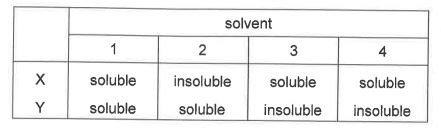
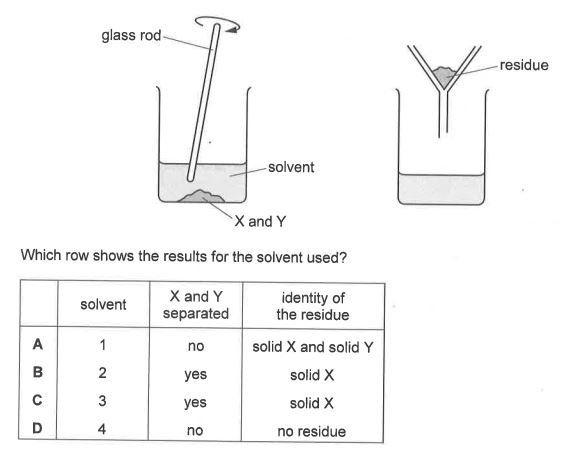
Answer: B. To separate two solids by stirring with a solvent and filtering, the solvent must dissolve exactly one of the two solids. The dissolved one passes through as filtrate; the other stays as residue.
Solvent 1 dissolves both X and Y, so no separation occurs. Option A wrongly claims a residue of both solids would form.
Solvent 2 dissolves Y but not X. X stays as residue and Y leaves as filtrate — separation succeeds with residue = X. This matches option B.
Solvents 3 and 4 both dissolve X but not Y. The residue in each case would be Y, not X. Option C wrongly says solvent 3 leaves X as residue. Option D wrongly says solvent 4 leaves no residue — but Y, being insoluble, would remain on the filter.
Get the Sec 3 / Sec 4 recording package
Every O Level Pure Chemistry TYS MCQ solution video, plus full Sec 3 / Sec 4 topic recordings.
Find out more