2025 O Level Chem P1 Q25 — Electrolysis of Aqueous Solutions Solution
Question
Video Solution
Explanation
Answer: D. 'Change in mass of both electrodes' means atoms are deposited at one and lost from the other.
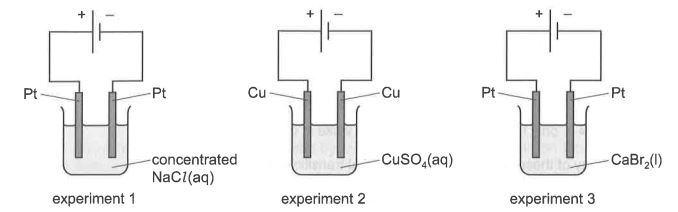
Experiment 1 (Pt electrodes, concentrated NaCl): inert platinum doesn't react. Gas is evolved at both electrodes — no mass change.
Experiment 2 (Cu electrodes, CuSO₄(aq)): the textbook electrorefining set-up. At the anode, copper dissolves: \(\text{Cu} \rightarrow \text{Cu}^{2+} + 2\text{e}^{-}\) (anode loses mass). At the cathode, \(\text{Cu}^{2+} + 2\text{e}^{-} \rightarrow \text{Cu}\) (cathode gains mass). Both electrodes change in mass. ✓
Experiment 3 (Pt electrodes, molten \(\text{CaBr}_2\)): Br₂ at anode (gas), Ca deposited at cathode (mass gain). Anode is inert Pt, no mass change. Only cathode changes mass.
Only experiment 2 has mass change at both electrodes → D.
Get the Sec 3 / Sec 4 recording package
Every O Level Pure Chemistry TYS MCQ solution video, plus full Sec 3 / Sec 4 topic recordings.
Find out more