2025 O Level Chem P1 Q20 — Reversible Reactions / Haber Process Solution
Question
Video Solution
Explanation
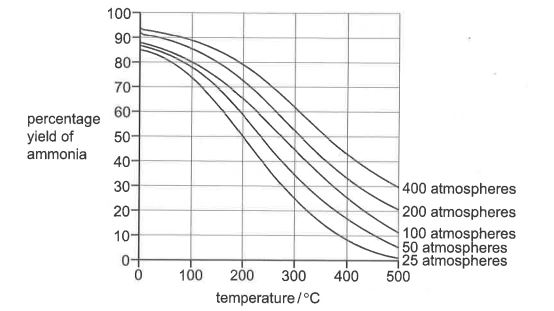
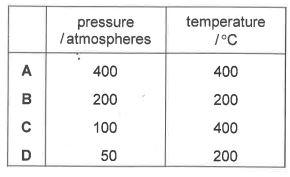
Answer: B. Read the graph: yield is plotted against temperature (x-axis) for various pressures.
The ammonia synthesis \(\text{N}_2 + 3\text{H}_2 \rightleftharpoons 2\text{NH}_3\) is exothermic and reduces gas moles. By Le Chatelier's principle: high pressure shifts equilibrium to the right (more product), and low temperature also shifts right (favours exothermic direction). So highest yield = highest pressure + lowest temperature.
Among the four options, B (200 atm, 200 °C) is the highest pressure × lowest temperature combination, giving the highest yield on the graph.
Note: in industry, a moderate ~450 °C is used despite the lower yield because the rate is too slow at 200 °C — but the question only asks about yield, not industrial practicality.
Get the Sec 3 / Sec 4 recording package
Every O Level Pure Chemistry TYS MCQ solution video, plus full Sec 3 / Sec 4 topic recordings.
Find out more