2024 O Level Chem P1 Q7 — Diffusion / Kinetic Particle Theory Solution
Question
Video Solution
Explanation
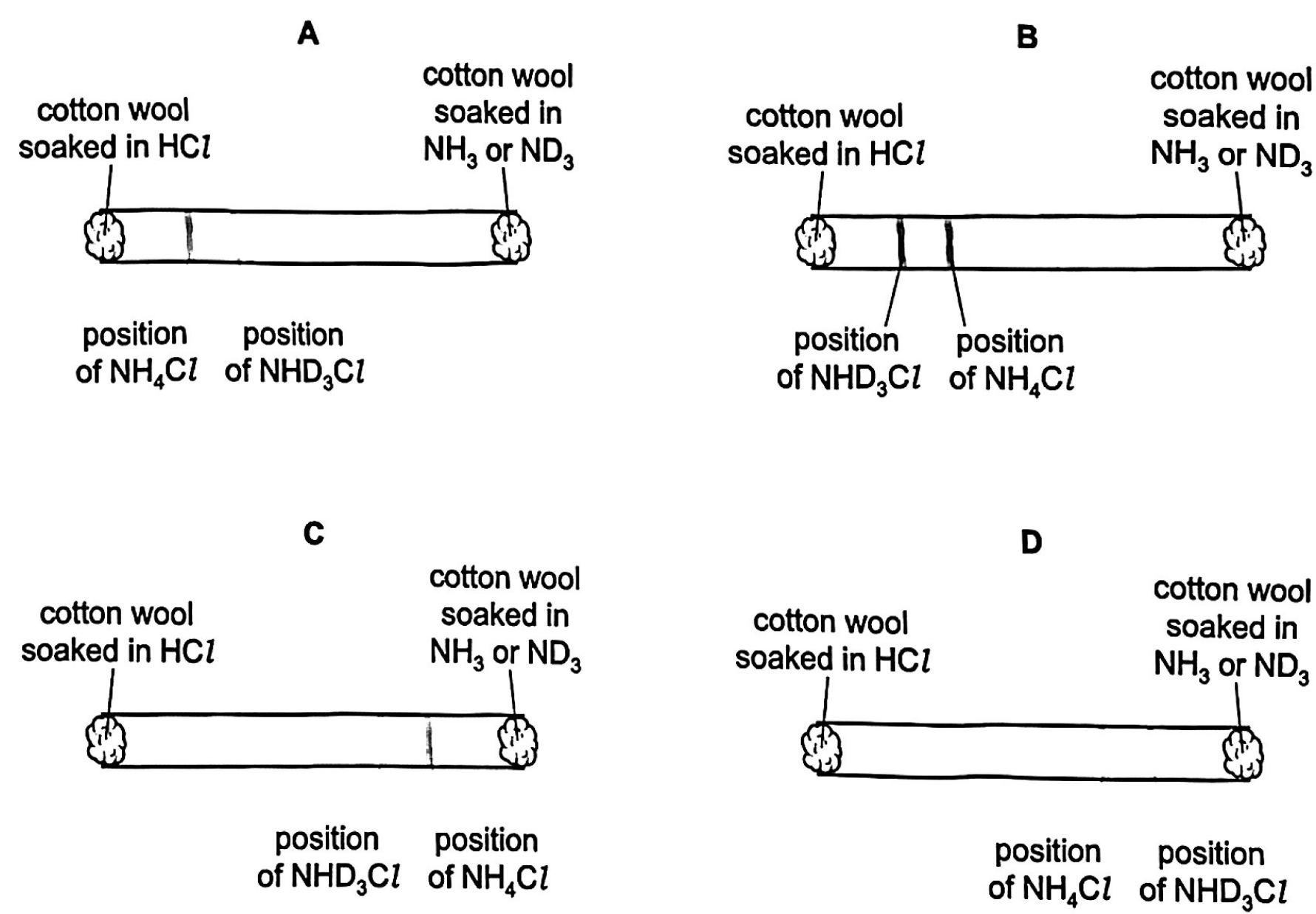
Answer: A. HCl (\(M_r\) = 36.5) is heaviest; both \(\text{NH}_3\) (\(M_r\) = 17) and \(\text{ND}_3\) (\(M_r\) = 20) are lighter, so both diffuse faster than HCl. The white ring forms where the gases meet, which is closer to the slower (heavier) gas — i.e., closer to the HCl end.
\(\text{NH}_3\) is lighter than \(\text{ND}_3\), so it diffuses fastest and meets HCl earliest. \(\text{NH}_4\text{Cl}\) ring forms most leftward (closest to HCl). \(\text{NHD}_3\text{Cl}\) forms slightly to the right of the \(\text{NH}_4\text{Cl}\) position, but still on the HCl half. Option A shows both rings on the HCl side, with \(\text{NH}_4\text{Cl}\) further left than \(\text{NHD}_3\text{Cl}\) — matching the physics.
Get the Sec 3 / Sec 4 recording package
Every O Level Pure Chemistry TYS MCQ solution video, plus full Sec 3 / Sec 4 topic recordings.
Find out more