2024 O Level Chem P1 Q5 — Chromatography Solution
Question
Three samples of colourless compounds, X, Y and Z, are investigated using paper chromatography. The chromatogram obtained is shown. Which statement about the chromatography investigation is correct?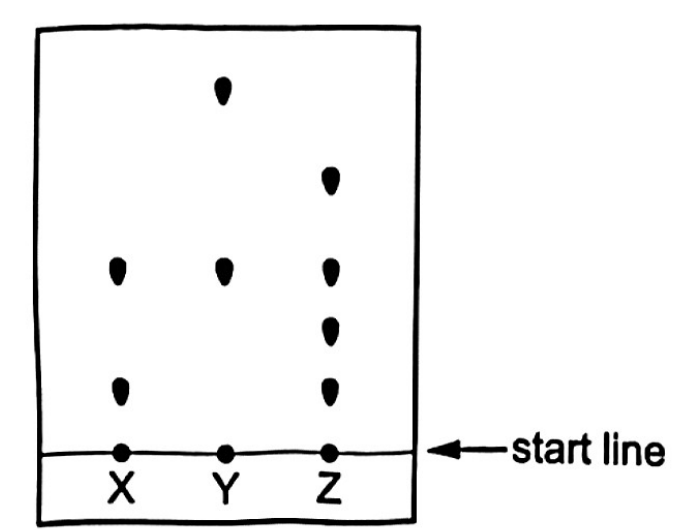
Correct answer: A
Video Solution
Explanation
Answer: A. The samples are colourless. For their spots to appear on the chromatogram at all, a locating agent — UV light or a chemical spray such as ninhydrin — must be used to develop the spots. The chromatogram as shown therefore confirms a locating agent was applied.
B is wrong: a single spot for X tells us only that any components in X have the same \(R_f\) under these conditions. There may still be co-eluting compounds. C is wrong: chromatography shows separation, not absolute purity (a single spot isn't proof). D is wrong: the \(R_f\) ratios shown aren't necessarily a clean 1:2 between samples — read the diagram, not symmetry.
Get the Sec 3 / Sec 4 recording package
Every O Level Pure Chemistry TYS MCQ solution video, plus full Sec 3 / Sec 4 topic recordings.
Find out more