2024 O Level Chem P1 Q34 — Alkanes / Substitution Reactions Solution
Question
Video Solution
Explanation
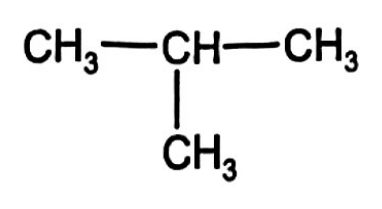
Answer: C. 2-methylpropane has the structure \((\text{CH}_3)_3\text{CH}\) — three equivalent methyl carbons and one tertiary CH carbon. There are 9 primary H atoms (on the three CH₃ groups) and 1 tertiary H atom.
Substituting two H atoms by Cl in \(\text{C}_4\text{H}_9\text{Cl}_2\) gives the following distinct isomers:
(i) both Cl on the same primary carbon: 1,1-dichloro-2-methylpropane.
(ii) one Cl each on two different primary carbons: 1,3-dichloro-2-methylpropane.
(iii) one Cl on a primary carbon, one Cl on the tertiary carbon: 1,2-dichloro-2-methylpropane.
(iv) one Cl on a primary carbon and another on the same tertiary carbon — but the tertiary C has only one H, so two Cl on it is impossible.
Counting: there are 4 distinct isomers.
Get the Sec 3 / Sec 4 recording package
Every O Level Pure Chemistry TYS MCQ solution video, plus full Sec 3 / Sec 4 topic recordings.
Find out more