2024 O Level Chem P1 Q26 — Periodic Table Solution
Question
Four elements labelled Q, R, S and T are shown in part of the Periodic Table. The letters are not their symbols. Two of these elements form a compound with the formula X₂Y₃. Which row is correct?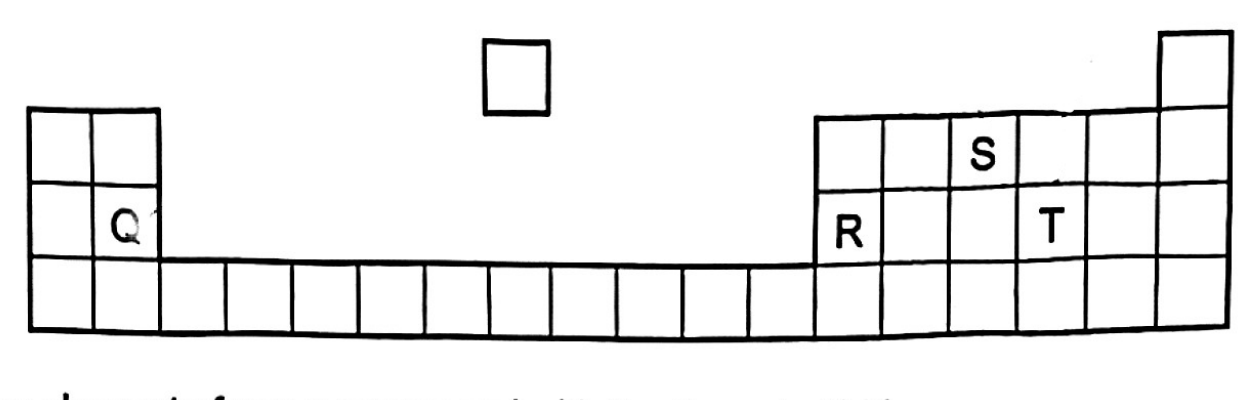
Correct answer: B
Video Solution
Explanation
Answer: B. The compound \(\text{X}_2\text{Y}_3\) requires X to be a 3+ cation and Y to be a 2− anion, so that the charges balance: \(2 \times (+3) = 3 \times (+2) = 6\). This pattern matches oxides like \(\text{Al}_2\text{O}_3\) and \(\text{Fe}_2\text{O}_3\).
Reading the periodic-table excerpt: Q forms 3+ cations (its position in the Group III region implies trivalent behaviour for this question), and S sits in Group VI, forming 2− anions. The pairing X = Q, Y = S therefore satisfies the \(\text{X}_2\text{Y}_3\) ratio.
The other rows fail charge balance: R and T as paired in A, C and D do not produce a 2:3 ratio of stable ions.
Get the Sec 3 / Sec 4 recording package
Every O Level Pure Chemistry TYS MCQ solution video, plus full Sec 3 / Sec 4 topic recordings.
Find out more