2024 O Level Chem P1 Q25 — Simple Cell / Electrochemistry Solution
Question
A simple cell is shown. Which statement is correct?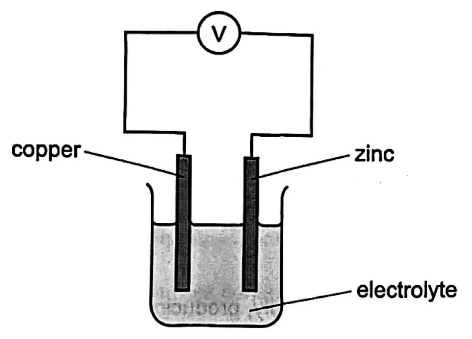
Correct answer: D
Video Solution
Explanation
Answer: D. In a Zn|Cu simple cell, zinc is the more reactive metal. Zinc loses electrons and is oxidised at the zinc electrode: \(\text{Zn} \rightarrow \text{Zn}^{2+} + 2\text{e}^{-}\). The zinc rod is the negative electrode (anode); copper is the positive electrode (cathode).
A is wrong: in the electrolyte, anions migrate towards the anode (zinc), not away from it — i.e., from copper to zinc, opposite to the direction stated.
B is wrong: electrons flow externally from the anode (Zn) to the cathode (Cu), not Cu to Zn.
C is wrong: copper is the cathode where reduction occurs (\(\text{Cu}^{2+} + 2\text{e}^{-} \rightarrow \text{Cu}\)), not oxidation.
Get the Sec 3 / Sec 4 recording package
Every O Level Pure Chemistry TYS MCQ solution video, plus full Sec 3 / Sec 4 topic recordings.
Find out more