2023 O Level Chem P1 Q36 — Cracking / Alkenes / Haber Process Solution
Question
Video Solution
Explanation
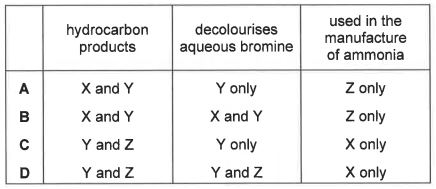
Answer: B. Z hardens unsaturated vegetable oils — this is the hydrogenation reaction, so Z = \(\text{H}_2\). Balance the equation: LHS = \(\text{C}_{16}\text{H}_{34}\); RHS already accounts for \(\text{Y} = \text{C}_{10}\text{H}_{20}\) and \(\text{Z} = \text{H}_2\), leaving \(3\text{X} = \text{C}_6\text{H}_{12}\) → X = \(\text{C}_2\text{H}_4\) (ethene).
Hydrocarbon products: X (\(\text{C}_2\text{H}_4\)) and Y (\(\text{C}_{10}\text{H}_{20}\)) are hydrocarbons; Z (\(\text{H}_2\)) is not.
Decolourises aqueous bromine: alkenes do. X is an alkene; Y fits \(\text{C}_n\text{H}_{2n}\) and is also an alkene from cracking. So both X and Y decolourise bromine. Z is \(\text{H}_2\) and does not.
Used in the manufacture of ammonia: \(\text{H}_2\) (Haber process) — so Z only. All three columns match row B.
Get the Sec 3 / Sec 4 recording package
Every O Level Pure Chemistry TYS MCQ solution video, plus full Sec 3 / Sec 4 topic recordings.
Find out more