2023 O Level Chem P1 Q31 — Alloys Solution
Question
Video Solution
Explanation
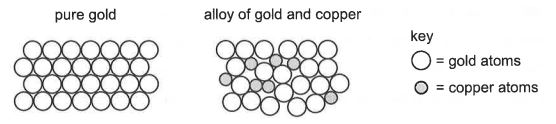
Answer: D. Different-sized atoms in an alloy disrupt the regular layers of the pure metal lattice, preventing them from sliding past one another under stress. This makes the alloy harder than the pure metal — option D is correct, and is the main reason alloys are used in jewellery and structural applications.
A — wrong: alloying typically changes (usually lowers) the melting point relative to the pure metal, because the regular lattice is disrupted. The alloy does not have the same m.p. as pure gold.
B — wrong: a 3:1 atom ratio of Au:Cu is not the same as 75% Au by mass. Mass-% depends on relative atomic masses (\(A_r(\text{Au}) = 197\); \(A_r(\text{Cu}) = 64\)), so 3:1 by atoms gives ~90% by mass, not 75%.
C — wrong: an alloy is a mixture of metallic elements, not a compound. There is no fixed stoichiometric ratio and no new chemical bonding between Au and Cu beyond the metallic bonding already present.
Get the Sec 3 / Sec 4 recording package
Every O Level Pure Chemistry TYS MCQ solution video, plus full Sec 3 / Sec 4 topic recordings.
Find out more