2023 O Level Chem P1 Q26 — Preparation of Salts Solution
Question
Video Solution
Explanation
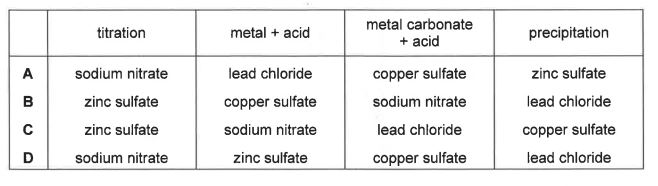
Answer: D. Match each salt to the method appropriate for its solubility and the reactivity of its metal.
Titration (acid + alkali) gives soluble salts of Group I metals — \(\text{HNO}_3 + \text{NaOH} \rightarrow \text{NaNO}_3\). So sodium nitrate.
Metal + acid works for a metal that's reactive enough to react with dilute acid but not too reactive: \(\text{Zn} + \text{H}_2\text{SO}_4 \rightarrow \text{ZnSO}_4 + \text{H}_2\). So zinc sulfate. (Cu won't react with dilute acid; Na would be far too violent.)
Metal carbonate + acid suits transition metals whose metal doesn't react with dilute acid: \(\text{CuCO}_3 + \text{H}_2\text{SO}_4 \rightarrow \text{CuSO}_4 + \text{H}_2\text{O} + \text{CO}_2\). So copper sulfate.
Precipitation mixes two soluble salts to produce an insoluble one: \(\text{Pb(NO}_3\text{)}_2 + 2\text{NaCl} \rightarrow \text{PbCl}_2\text{(s)} + 2\text{NaNO}_3\). So lead chloride. All four pairings match row D.
Get the Sec 3 / Sec 4 recording package
Every O Level Pure Chemistry TYS MCQ solution video, plus full Sec 3 / Sec 4 topic recordings.
Find out more