2023 O Level Chem P1 Q25 — Strong vs Weak Acids Solution
Question
Video Solution
Explanation
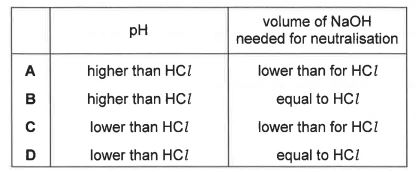
Answer: B. HCl is a strong acid (fully dissociates). Ethanoic acid is a weak acid (partially dissociates). At the same concentration, ethanoic acid has a lower \([\text{H}^+]\) than HCl, so its pH is higher than 1.0.
For neutralisation, the total moles of acid (not its degree of dissociation) determines how much NaOH is needed. As \(\text{H}^+\) is consumed, more of the weak acid dissociates to replace it — the reaction continues until all the acid molecules have reacted with NaOH.
Both acids are monobasic, at the same concentration and the same volume (50.0 cm³), so both contain the same moles of acid. They therefore need the same moles — and the same volume — of NaOH: 25.0 cm³. So pH higher than HCl; volume of NaOH equal to HCl. Row B.
Get the Sec 3 / Sec 4 recording package
Every O Level Pure Chemistry TYS MCQ solution video, plus full Sec 3 / Sec 4 topic recordings.
Find out more