2023 O Level Chem P1 Q23 — Rate of Reaction Solution
Question
Video Solution
Explanation
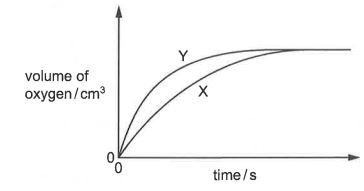
Answer: C. Curve Y reaches the same plateau as X (so the maximum moles of \(\text{O}_2\), and therefore the moles of \(\text{H}_2\text{O}_2\) that decomposed, are unchanged) but climbs to it more steeply (faster initial rate).
(1) Increasing the concentration of \(\text{H}_2\text{O}_2\) — but the stem fixes the volume of \(\text{H}_2\text{O}_2\). Higher concentration would mean more moles of \(\text{H}_2\text{O}_2\), giving more \(\text{O}_2\) — a higher plateau, not the same one. Inconsistent with curve Y. ✗
(2) Using a catalyst — speeds the reaction without changing the moles produced. Same plateau, steeper curve. ✓
(3) Increasing temperature — also speeds the reaction; the moles available to decompose are unchanged. Same plateau, steeper curve. ✓
So 2 and 3 only: option C.
Get the Sec 3 / Sec 4 recording package
Every O Level Pure Chemistry TYS MCQ solution video, plus full Sec 3 / Sec 4 topic recordings.
Find out more