2023 O Level Chem P1 Q21 — Energetics / Catalysts Solution
Question
Video Solution
Explanation
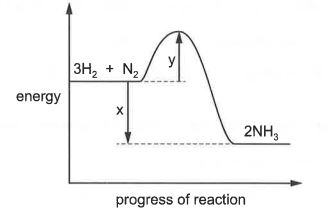
Answer: D. The reaction \(\text{N}_2 + 3\text{H}_2 \rightarrow 2\text{NH}_3\) is exothermic — products sit lower on the energy profile than reactants. On the diagram, \(x\) is the activation energy of the forward reaction (reactants up to the peak) and \(y\) is the overall energy released (reactants down to products).
D — catalysts lower the activation energy by providing an alternative pathway, but they do not change the energy levels of reactants or products, so \(\Delta H\) is unchanged. ✓
A — activation energy of the reverse reaction is the peak minus the products' energy, which equals \(x + y\), not \(y\) alone.
B — \(\Delta H\) on the diagram (\(y\)) corresponds to formation of 2 mol \(\text{NH}_3\) (per the equation); per mole would be \(y/2\).
C — formation of \(\text{NH}_3\) is exothermic (products lower than reactants), not endothermic.
Get the Sec 3 / Sec 4 recording package
Every O Level Pure Chemistry TYS MCQ solution video, plus full Sec 3 / Sec 4 topic recordings.
Find out more