2023 O Level Chem P1 Q20 — Simple Cells / Electrochemistry Solution
Question
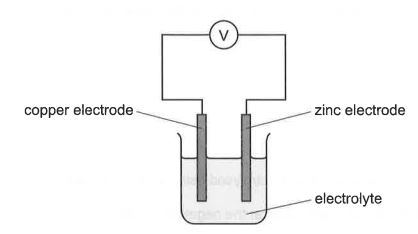
Video Solution
Explanation
Answer: C. In a simple cell the more reactive metal is oxidised at the negative electrode (anode); the less reactive metal's cation is reduced at the positive electrode (cathode). Zn is more reactive than Cu, so:
Negative electrode (Zn): \(\text{Zn(s)} \rightarrow \text{Zn}^{2+}\text{(aq)} + 2e^-\) (oxidation)
Positive electrode (Cu): \(\text{Cu}^{2+}\text{(aq)} + 2e^- \rightarrow \text{Cu(s)}\) (reduction)
Option C pairs these correctly. ✓
A pairs two reductions (\(\text{Cu}^{2+}\rightarrow\text{Cu}\) and \(\text{Zn}^{2+}\rightarrow\text{Zn}\)) — chemically impossible in a single cell because no electrons are released to drive the external circuit. B pairs two oxidations — equally impossible (no electrons consumed). D reverses the polarity (Zn²⁺ being reduced while Cu is oxidised), which would require Cu to be more reactive than Zn — it isn't.
Get the Sec 3 / Sec 4 recording package
Every O Level Pure Chemistry TYS MCQ solution video, plus full Sec 3 / Sec 4 topic recordings.
Find out more