2023 O Level Chem P1 Q2 — Experimental Techniques / Mole Calculations Solution
Question
Video Solution
Explanation
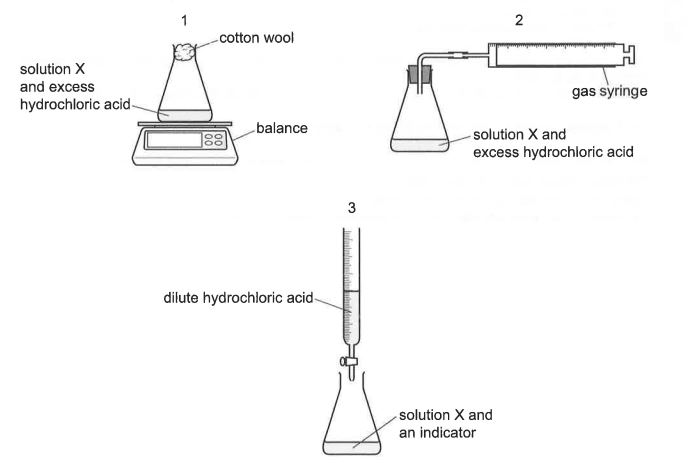
Answer: A. Reactions with dilute HCl: \(\text{NaOH} + \text{HCl} \rightarrow \text{NaCl} + \text{H}_2\text{O}\) (no gas); \(\text{Na}_2\text{CO}_3 + 2\text{HCl} \rightarrow 2\text{NaCl} + \text{H}_2\text{O} + \text{CO}_2\) (gas). Only the carbonate releases \(\text{CO}_2\), so any method measuring the \(\text{CO}_2\) produced gives moles of \(\text{Na}_2\text{CO}_3\) selectively.
Apparatus 1 (balance, mass loss as \(\text{CO}_2\) escapes): valid — the mass loss equals the mass of \(\text{CO}_2\), from which moles can be calculated. Apparatus 2 (gas syringe): valid — volume of \(\text{CO}_2\) at r.t.p. converts to moles using \(24\,\text{dm}^3/\text{mol}\).
Apparatus 3 (titrating solution X with HCl + indicator) measures the total moles of NaOH plus \(\text{Na}_2\text{CO}_3\) — both neutralise the acid. It cannot isolate the carbonate. So 1 and 2 only: option A.
Get the Sec 3 / Sec 4 recording package
Every O Level Pure Chemistry TYS MCQ solution video, plus full Sec 3 / Sec 4 topic recordings.
Find out more