2023 O Level Chem P1 Q19 — Electrolysis / States of Matter Solution
Question
Video Solution
Explanation
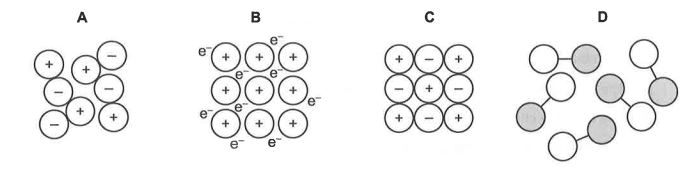
Answer: A. Electrolysis requires mobile ions that can move to the electrodes and be discharged. A metal conducts via mobile electrons but cannot be electrolysed (no ions to discharge); a solid ionic compound has ions but they are fixed in the lattice.
Diagram A — + and − ions in close contact but disordered, no rigid lattice. This is a molten ionic compound. Ions are mobile; the substance can be electrolysed at 300 °C. ✓
Diagram B — positive ions surrounded by \(e^-\) symbols (a sea of delocalised electrons) and no anions. This is a metallic structure. Metals conduct via electrons, not ions; they cannot be electrolysed.
Diagram C — regular alternating + and − ions in a fixed lattice → solid ionic. Ions locked in place; no electrolysis until melted. Diagram D — pairs of bonded atoms in random arrangement → simple molecular covalent. No ions, no mobile electrons — does not conduct.
Get the Sec 3 / Sec 4 recording package
Every O Level Pure Chemistry TYS MCQ solution video, plus full Sec 3 / Sec 4 topic recordings.
Find out more