2022 O Level Chem P1 Q9 — Empirical Formula / Organic Chemistry Solution
Question
Video Solution
Explanation
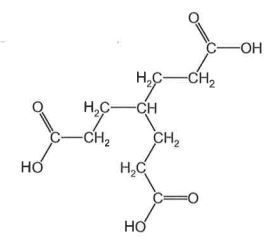
Answer: C. Read the molecular formula from the structure first, then divide by the highest common factor.
The compound has a central CH bonded to three identical \(-\text{CH}_2\text{CH}_2\text{COOH}\) arms — equivalent to \(\text{HC(C}_3\text{H}_5\text{O}_2)_3\). Expanding: carbons = \(1 + 3 \times 3 = 10\); hydrogens = \(1 + 3 \times 5 = 16\); oxygens = \(3 \times 2 = 6\). Molecular formula = \(\text{C}_{10}\text{H}_{16}\text{O}_6\).
Empirical formula = divide subscripts by HCF. 10, 16, 6 share an HCF of 2. So empirical formula = \(\text{C}_5\text{H}_8\text{O}_3\) — option C.
Option A (\(\text{HC(C}_3\text{H}_5\text{O}_2)_3\)) is the structural formula style, not the empirical formula. Option B is the formula of one arm only. Option D is the molecular formula, which is not the simplest ratio.
Get the Sec 3 / Sec 4 recording package
Every O Level Pure Chemistry TYS MCQ solution video, plus full Sec 3 / Sec 4 topic recordings.
Find out more