2022 O Level Chem P1 Q40 — Condensation Polymerisation / Nylon Solution
Question
Video Solution
Explanation
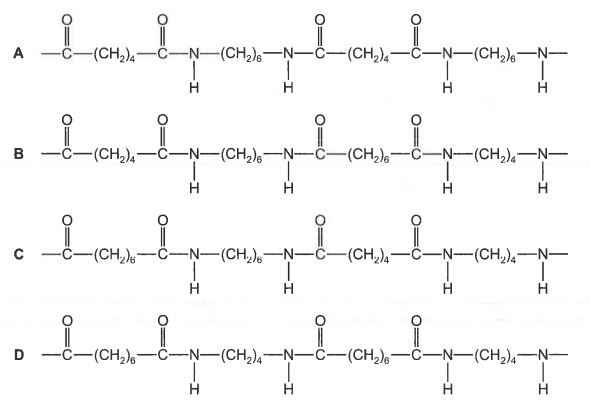
Answer: A. Condensation polymerisation of a diamine with a dicarboxylic acid forms amide linkages (–CO–NH–), eliminating one \(\text{H}_2\text{O}\) per linkage. Each monomer contributes its carbon skeleton between the new linkages:
• Adipic acid \(\text{HOOC}{-}(\text{CH}_2)_4{-}\text{COOH}\) contributes \({-}\text{CO}{-}(\text{CH}_2)_4{-}\text{CO}{-}\) — the (CH₂)₄ chain sits between two C=O groups.
• Hexamethylenediamine \(\text{H}_2\text{N}{-}(\text{CH}_2)_6{-}\text{NH}_2\) contributes \({-}\text{NH}{-}(\text{CH}_2)_6{-}\text{NH}{-}\) — the (CH₂)₆ chain sits between two N–H groups.
So the repeating unit alternates: \({-}\text{CO}{-}(\text{CH}_2)_4{-}\text{CO}{-}\text{NH}{-}(\text{CH}_2)_6{-}\text{NH}{-}\). Row A shows exactly this: (CH₂)₄ between two C=O groups and (CH₂)₆ between two N–H groups.
Rows B, C and D swap the chain lengths — they put (CH₂)₆ between two C=O groups (wrong — adipic acid has only 4 CH₂ between the COOH ends) or put (CH₂)₄ between two N–H groups (wrong — the diamine has 6 CH₂ between the NH₂ ends). Only A is internally consistent.
Get the Sec 3 / Sec 4 recording package
Every O Level Pure Chemistry TYS MCQ solution video, plus full Sec 3 / Sec 4 topic recordings.
Find out more