2022 O Level Chem P1 Q38 — Esters Solution
Question
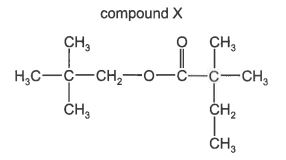
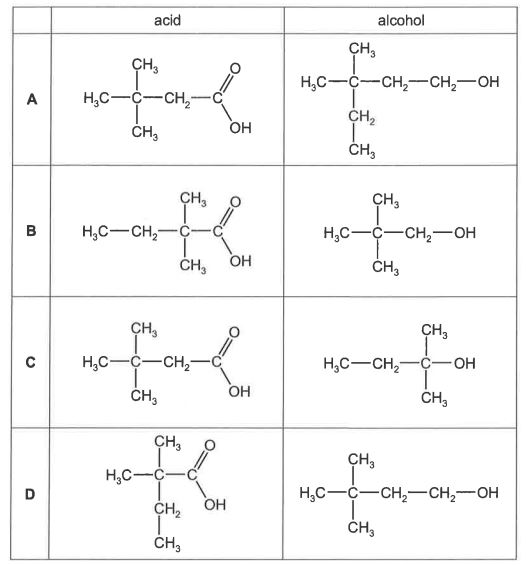
Video Solution
Explanation
Answer: B. Hydrolyse the ester at the C–O–C(=O) bond. The alcohol fragment keeps the –OH (it was the –O–); the acid fragment keeps the –COOH (it was the –C(=O)–).
Compound X: \((\text{CH}_3)_3\text{C}{-}\text{CH}_2{-}\text{O}{-}\text{CO}{-}\text{C(CH}_3)_2{-}\text{CH}_2\text{CH}_3\).
Left of the linkage (alcohol side): \((\text{CH}_3)_3\text{C}{-}\text{CH}_2{-}\). Add –OH to make the alcohol: \((\text{CH}_3)_3\text{C}{-}\text{CH}_2\text{OH}\) = 2,2-dimethylpropan-1-ol (neopentyl alcohol).
Right of the linkage (acid side): \({-}\text{CO}{-}\text{C(CH}_3)_2{-}\text{CH}_2\text{CH}_3\). Add –OH to make the acid: \(\text{HOOC}{-}\text{C(CH}_3)_2{-}\text{CH}_2\text{CH}_3\) = 2,2-dimethylbutanoic acid.
Row B pairs exactly this acid with this alcohol. The other rows either move the methyl branching one carbon away from the –COOH (giving 3,3-dimethylbutanoic acid, wrong acid) or shorten the alcohol chain, so they do not hydrolyse back to compound X.
Get the Sec 3 / Sec 4 recording package
Every O Level Pure Chemistry TYS MCQ solution video, plus full Sec 3 / Sec 4 topic recordings.
Find out more