2022 O Level Chem P1 Q35 — Manufacture of Ethanol Solution
Question
Video Solution
Explanation
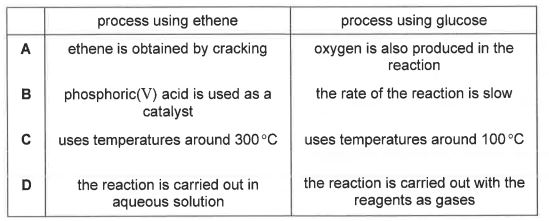
Answer: B. The two industrial routes to ethanol differ in conditions and rate:
Ethene route — hydration: \(\text{C}_2\text{H}_4 + \text{H}_2\text{O} \rightarrow \text{C}_2\text{H}_5\text{OH}\), with phosphoric(V) acid catalyst, ~300 °C, high pressure. Fast and continuous.
Glucose route — fermentation: \(\text{C}_6\text{H}_{12}\text{O}_6 \rightarrow 2\text{C}_2\text{H}_5\text{OH} + 2\text{CO}_2\), with yeast enzymes at ~30 °C. Slow, batch biological process.
Row B states both facts correctly: ethene route uses \(\text{H}_3\text{PO}_4\) catalyst ✓; glucose route is slow ✓.
A is wrong: neither route produces oxygen (fermentation makes \(\text{CO}_2\)).
C is wrong: fermentation at 100 °C would denature the enzymes.
D is wrong: fermentation runs in aqueous solution (yeast lives in water), not as gas-phase.
Get the Sec 3 / Sec 4 recording package
Every O Level Pure Chemistry TYS MCQ solution video, plus full Sec 3 / Sec 4 topic recordings.
Find out more