2022 O Level Chem P1 Q31 — States of Matter Solution
Question
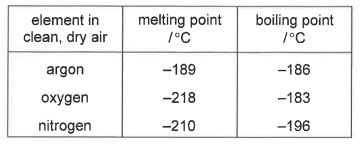
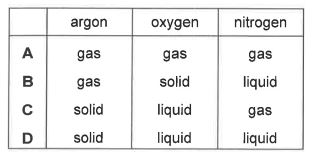
Video Solution
Explanation
Answer: C. Apply the rule: at temperature \(T\), a substance is solid if \(T < \text{m.p.}\), liquid if \(\text{m.p.} \leq T \leq \text{b.p.}\), and gas if \(T > \text{b.p.}\). All comparisons are with \(T = -190\) °C.
Argon: m.p. \(-189\), b.p. \(-186\). \(-190 < -189\) → solid.
Oxygen: m.p. \(-218\), b.p. \(-183\). \(-218 < -190 < -183\) → liquid.
Nitrogen: m.p. \(-210\), b.p. \(-196\). \(-190 > -196\) → gas.
States (argon, oxygen, nitrogen) = (solid, liquid, gas) → row C.
The common mistake here is comparing magnitudes of negative numbers the wrong way round. Remember \(-190\) is HIGHER than \(-196\) on the temperature scale, even though 190 is the smaller magnitude.
Get the Sec 3 / Sec 4 recording package
Every O Level Pure Chemistry TYS MCQ solution video, plus full Sec 3 / Sec 4 topic recordings.
Find out more