2022 O Level Chem P1 Q3 — Qualitative Analysis Solution
Question
Video Solution
Explanation
Answer: C. The mixture is known to contain sodium. The two tests identify the remaining ions.
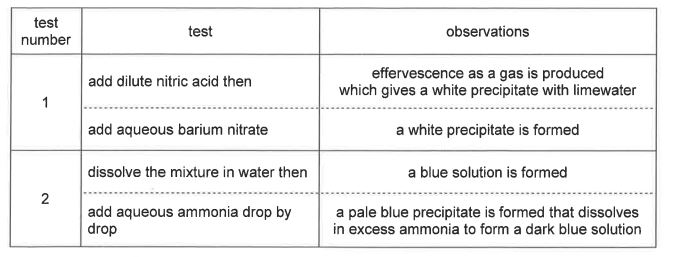
Test 1: adding dilute \(\text{HNO}_3\) gives effervescence; the gas produces a white precipitate with limewater — this is the test for \(\text{CO}_2\), so a carbonate ion is present. Adding \(\text{Ba(NO}_3\text{)}_2\) then gives a white precipitate (\(\text{BaSO}_4\)), confirming a sulfate ion.
Test 2: dissolving in water gives a blue solution — this is the colour of \(\text{Cu}^{2+}\). Adding aqueous ammonia drop by drop gives a pale-blue precipitate that dissolves in excess to a dark-blue solution — the classic test for \(\text{Cu}^{2+}\), forming \([\text{Cu(NH}_3)_4]^{2+}\).
So the ions present are \(\text{Na}^+\), \(\text{CO}_3^{2-}\), \(\text{SO}_4^{2-}\) and \(\text{Cu}^{2+}\). Two salts fit: sodium carbonate and copper(II) sulfate — option C.
Get the Sec 3 / Sec 4 recording package
Every O Level Pure Chemistry TYS MCQ solution video, plus full Sec 3 / Sec 4 topic recordings.
Find out more