2022 O Level Chem P1 Q23 — Preparation of Salts Solution
Question
Video Solution
Explanation
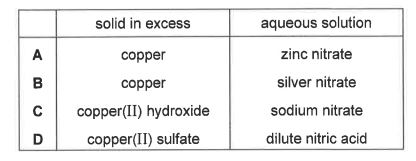
Answer: B. The recipe is "powdered solid + aqueous solution, filter, crystallise the filtrate" — i.e. a displacement reaction. The solid must be more reactive than the metal in the aqueous solution; the desired product \(\text{Cu(NO}_3)_2\) must end up in the filtrate.
Option B: \(\text{Cu(s)} + 2\text{AgNO}_3\text{(aq)} \rightarrow \text{Cu(NO}_3)_2\text{(aq)} + 2\text{Ag(s)}\). Cu is more reactive than Ag, so the reaction proceeds. The displaced silver metal is filtered off; the filtrate is aqueous \(\text{Cu(NO}_3)_2\), which crystallises on evaporation. ✓
A: Cu + \(\text{Zn(NO}_3)_2\) — Cu is less reactive than Zn, no displacement.
C: \(\text{Cu(OH)}_2\) + \(\text{NaNO}_3\) — neither reaction nor dissolution; \(\text{Cu(OH)}_2\) is insoluble in neutral solution.
D: \(\text{CuSO}_4\) + dilute \(\text{HNO}_3\) — no reaction; you'd end up with \(\text{CuSO}_4\) plus acid, not pure \(\text{Cu(NO}_3)_2\).
Get the Sec 3 / Sec 4 recording package
Every O Level Pure Chemistry TYS MCQ solution video, plus full Sec 3 / Sec 4 topic recordings.
Find out more