2022 O Level Chem P1 Q21 — Acids and Bases Solution
Question
Video Solution
Explanation
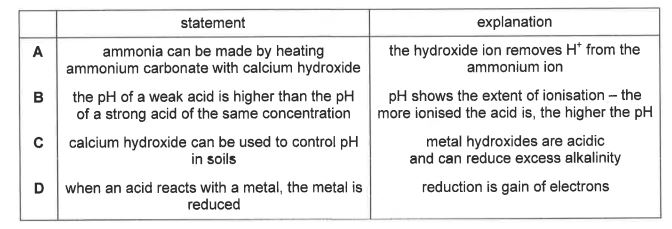
Answer: A. Pair each statement with its explanation and check both are correct.
A: heating \((\text{NH}_4)_2\text{CO}_3\) with \(\text{Ca(OH)}_2\) liberates ammonia, and the explanation — that the \(\text{OH}^-\) ion removes \(\text{H}^+\) from \(\text{NH}_4^+\) — is the correct mechanism: \(\text{NH}_4^+ + \text{OH}^- \rightarrow \text{NH}_3 + \text{H}_2\text{O}\). Both parts ✓.
B is wrong: a weak acid at the same concentration has a higher pH than a strong acid (correct statement), but the explanation reverses the relationship — "more ionised → higher pH" is wrong. More ionisation means more \(\text{H}^+\), which means lower pH.
C is wrong: calcium hydroxide can control acidic soil pH (correct statement), but the explanation — "metal hydroxides are acidic" — is the opposite of the truth. Metal hydroxides are basic.
D is wrong: when an acid reacts with a metal the metal is oxidised, not reduced. The explanation also defines reduction backwards.
Get the Sec 3 / Sec 4 recording package
Every O Level Pure Chemistry TYS MCQ solution video, plus full Sec 3 / Sec 4 topic recordings.
Find out more