2022 O Level Chem P1 Q2 — Chromatography Solution
Question
Video Solution
Explanation
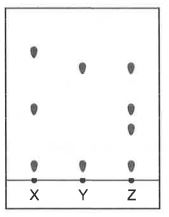
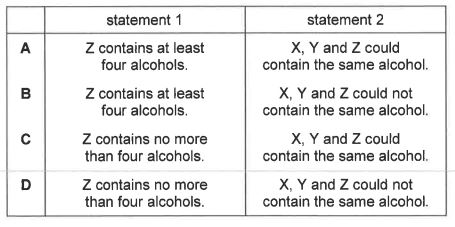
Answer: A. Sample Z's column on the chromatogram shows four distinct spots — i.e. at least four alcohols are present in Z. So statement 1 ("Z contains at least four alcohols") is true. This rules out C and D, which both claim Z contains no more than four.
Statement 2 is about whether X, Y and Z could share an alcohol. Sharing an alcohol means having spots at the same \(R_f\) value (the same vertical height). The chromatogram shows that spots from X, Y and Z do line up at some heights — so it is possible that all three contain the same alcohol. "Could contain" is the correct claim.
Row A says "at least four" + "could contain the same alcohol" — both match the chromatogram. Row B keeps statement 1 correct but flips statement 2 to "could not", which is too strong an assertion when at least some heights overlap.
Get the Sec 3 / Sec 4 recording package
Every O Level Pure Chemistry TYS MCQ solution video, plus full Sec 3 / Sec 4 topic recordings.
Find out more