2022 O Level Chem P1 Q18 — Rate of Reaction Solution
Question
Video Solution
Explanation
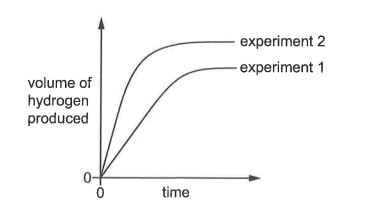
Answer: B. Curve 2 starts steeper and finishes at a higher plateau than curve 1. The steepness is the rate at \(t = 0\); the plateau height is the total volume of \(\text{H}_2\) produced when the reaction is complete (so it tells you how many moles of limiting reactant there were).
If experiment 2 produces more total \(\text{H}_2\), then it had more limiting reactant. The acid was fixed at 50 cm³ of 0.50 mol/dm³ → 0.025 mol acid → 0.0125 mol Zn needed. Increasing zinc (option B) past the original 1.0 g still gives more total \(\text{H}_2\) because experiment 1's zinc was the limiting reactant.
A (catalyst) and C (higher temperature) speed the reaction up but don't change the plateau — they'd give a steeper curve to the same height. D (more concentrated acid) increases the moles of acid but doesn't help if zinc was already limiting. Only B explains both a steeper start AND a higher plateau.
Get the Sec 3 / Sec 4 recording package
Every O Level Pure Chemistry TYS MCQ solution video, plus full Sec 3 / Sec 4 topic recordings.
Find out more