2022 O Level Chem P1 Q14 — Electroplating Solution
Question
Video Solution
Explanation
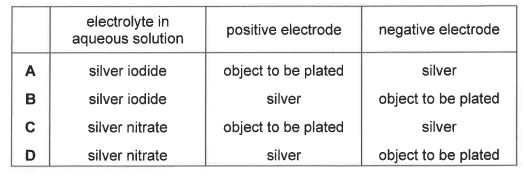
Answer: D. Three rules for electroplating: (i) the electrolyte must contain ions of the plating metal; (ii) the positive electrode (anode) is the pure plating metal — it dissolves to replenish the ions in solution; (iii) the negative electrode (cathode) is the object to be plated.
For silver plating: the electrolyte must contain \(\text{Ag}^+\). Silver nitrate is soluble — silver iodide is not — so the electrolyte must be silver nitrate. That rules out A and B.
Between C and D, the polarity is the key: silver itself goes at the positive electrode (anode), where it loses electrons to become \(\text{Ag}^+\) and dissolves. The object to be plated is the negative electrode (cathode), where \(\text{Ag}^+ + e^- \rightarrow \text{Ag}\) deposits new metal onto its surface. That's row D.
Row C reverses the polarity — the silver electrode and the object are swapped — so it does not describe a working silver-plating cell.
Get the Sec 3 / Sec 4 recording package
Every O Level Pure Chemistry TYS MCQ solution video, plus full Sec 3 / Sec 4 topic recordings.
Find out more