2022 O Level Chem P1 Q13 — Electrolysis Solution
Question
Video Solution
Explanation
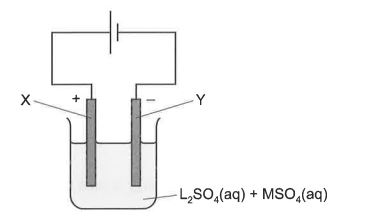
Answer: D. The electrolyte is a mixture of \(\text{L}_2\text{SO}_4\) and \(\text{MSO}_4\) — both aqueous and dilute. L is a Group I metal (very reactive). M is a less reactive transition metal.
At the negative electrode (cathode): the less reactive metal's cation is preferentially discharged. M is less reactive than L (and also less reactive than \(\text{H}^+\)/water), so \(\text{M}^{2+} + 2e^- \rightarrow \text{M(s)}\). The Group I metal cation stays in solution.
At the positive electrode (anode): with dilute sulfate solutions, \(\text{OH}^-\) / water is preferentially discharged over \(\text{SO}_4^{2-}\). The product is oxygen gas: \(4\text{OH}^- \rightarrow \text{O}_2 + 2\text{H}_2\text{O} + 4e^-\).
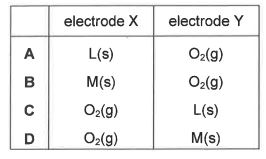
In the labelled cell, X is the positive (anode → \(\text{O}_2\)) and Y is the negative (cathode → M). Row D matches: X = \(\text{O}_2(\text{g})\), Y = \(\text{M}(\text{s})\).
Get the Sec 3 / Sec 4 recording package
Every O Level Pure Chemistry TYS MCQ solution video, plus full Sec 3 / Sec 4 topic recordings.
Find out more