2021 O Level Chem P1 Q37 — Organic Chemistry / Alkenes Solution
Question
Addition of hydrogen to an unknown alkene gives the alkane (CH₃)₃CH. What is the unknown alkene?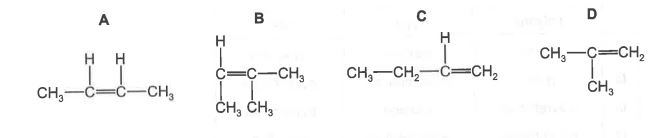
Correct answer: D
Video Solution
Explanation
Answer: D. Adding hydrogen across the C=C double bond of an alkene (hydrogenation) gives the corresponding alkane with the same carbon skeleton. The product here is (CH₃)₃CH, 2-methylpropane (isobutane), which has four carbons in a branched arrangement.
So the unknown alkene must have the same branched four-carbon skeleton with a C=C double bond: 2-methylpropene, (CH₃)₂C=CH₂. Hydrogenating it puts hydrogen across the double bond to give (CH₃)₃CH.
The straight-chain alkenes (but-1-ene and but-2-ene) would hydrogenate to give n-butane, not the branched 2-methylpropane, so they are wrong.
Get the Sec 3 / Sec 4 recording package
Every O Level Pure Chemistry TYS MCQ solution video, plus full Sec 3 / Sec 4 topic recordings.
Find out more