2020 O Level Chem P1 Q38 — Organic Chemistry / Alkenes and Hydration Solution
Question
Video Solution
Explanation
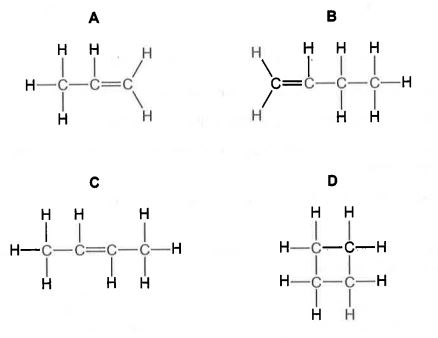
Answer: B (but-1-ene, CH₂=CHCH₂CH₃). The empirical formula CH₂ has a mass of 14, and the relative molecular mass is 56, so the molecular formula is \((\text{CH}_2)_n\) with \(14n = 56\), giving n = 4. So compound Z is C₄H₈, a butene. Reacting with steam means addition of water across the C=C double bond to form an alcohol.
Z must give two different alcohols, which means it is but-1-ene, CH₂=CHCH₂CH₃. Adding water can place the –OH on either of the two double-bond carbons, giving butan-1-ol or butan-2-ol — two alcohols with different structural formulae.
By contrast, but-2-ene is symmetrical, so hydration gives only butan-2-ol, a single alcohol, which fails the condition. Propene has the wrong \(M_r\) of 42, and cyclobutane is saturated so it does not add steam like an alkene. The answer is B.
Get the Sec 3 / Sec 4 recording package
Every O Level Pure Chemistry TYS MCQ solution video, plus full Sec 3 / Sec 4 topic recordings.
Find out more