2020 O Level Chem P1 Q37 — Organic Chemistry / Reactions of Ethene Solution
Question
Video Solution
Explanation
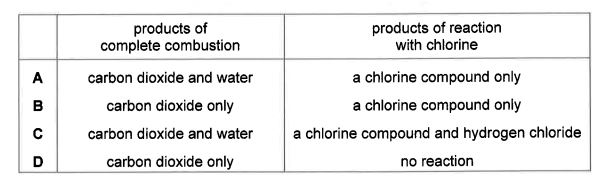
Answer: A (carbon dioxide and water; a chlorine compound only). The complete combustion of any hydrocarbon gives carbon dioxide and water: \(\text{C}_2\text{H}_4 + 3\text{O}_2 \to 2\text{CO}_2 + 2\text{H}_2\text{O}\). So the products of burning ethene completely are carbon dioxide and water.
Ethene reacting with chlorine is an addition reaction across the C=C double bond, giving a single product, 1,2-dichloroethane: \(\text{C}_2\text{H}_4 + \text{Cl}_2 \to \text{C}_2\text{H}_4\text{Cl}_2\). No hydrogen chloride is formed, because HCl comes from substitution reactions of alkanes, not addition reactions of alkenes.
So combustion gives CO₂ and H₂O, and the chlorine reaction gives a single chlorine compound. This is row A. Common error: writing HCl as a product of the chlorine reaction, confusing addition with substitution. The answer is A.
Get the Sec 3 / Sec 4 recording package
Every O Level Pure Chemistry TYS MCQ solution video, plus full Sec 3 / Sec 4 topic recordings.
Find out more