2020 O Level Chem P1 Q24 — Group VII / Halogen Displacement Solution
Question
Video Solution
Explanation
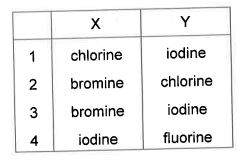
Answer: A (1 and 3). In the equation \(\text{X}_2 + 2\text{KY} \to \text{Y}_2 + 2\text{KX}\), element X displaces element Y from its salt, which means X must be more reactive than Y. In Group VII the reactivity, or oxidising power, decreases down the group: F > Cl > Br > I. So a halogen can only displace one below it.
Row 1 has X = chlorine and Y = iodine: chlorine is more reactive than iodine, so chlorine displaces iodide, \(\text{Cl}_2 + 2\text{KI} \to \text{I}_2 + 2\text{KCl}\) — this works. Row 3 has X = bromine and Y = iodine: bromine is more reactive than iodine, so bromine displaces iodide — this works too. Rows with bromine trying to displace chloride, or iodine trying to displace fluoride, fail because the displacing halogen is the less reactive one.
The valid combinations are 1 and 3, so the answer is A.
Get the Sec 3 / Sec 4 recording package
Every O Level Pure Chemistry TYS MCQ solution video, plus full Sec 3 / Sec 4 topic recordings.
Find out more