2020 O Level Chem P1 Q2 — Collection of Gases / Air Composition Solution
Question
Video Solution
Explanation
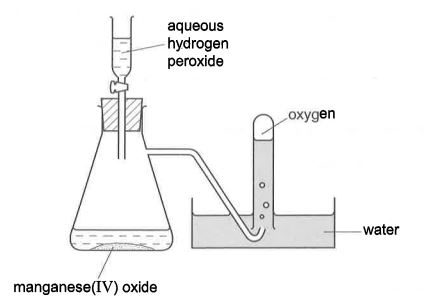
Answer: D (nitrogen). Before any oxygen is generated, the conical flask and delivery tube are already full of ordinary air. When the hydrogen peroxide starts to decompose, \(2\text{H}_2\text{O}_2 \to 2\text{H}_2\text{O} + \text{O}_2\), the oxygen produced first pushes this trapped air out through the delivery tube and into the first few collecting tubes.
Air is roughly 78% nitrogen and 21% oxygen, so the main gas displaced into those early tubes is nitrogen. That makes nitrogen the contaminant.
Why not the others? Hydrogen (A) is never formed, since the equation gives only water and oxygen. Hydrogen peroxide (B) is a liquid in the flask and does not bubble across as a gas. Manganese(IV) oxide (C) is a solid catalyst lying at the bottom of the flask, so it cannot travel into the gas tube either.
Get the Sec 3 / Sec 4 recording package
Every O Level Pure Chemistry TYS MCQ solution video, plus full Sec 3 / Sec 4 topic recordings.
Find out more