2020 O Level Chem P1 Q15 — Energetics / Bond Energy and Enthalpy Change Solution
Question
Video Solution
Explanation
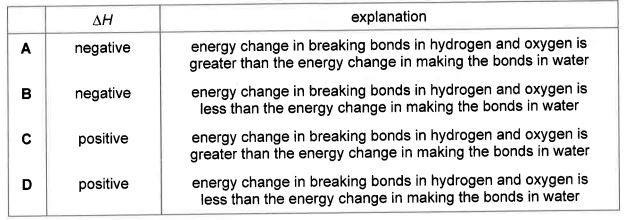
Answer: B (\(\Delta H\) is negative; energy to break bonds is less than energy released forming bonds). The combustion of hydrogen, \(2\text{H}_2(g) + \text{O}_2(g) \to 2\text{H}_2\text{O}(l)\), is strongly exothermic, so heat is given out and the enthalpy change \(\Delta H\) is negative.
Thinking in terms of bonds: breaking the H–H and O=O bonds in the reactants absorbs energy (endothermic), while forming the O–H bonds in water releases energy (exothermic). The overall \(\Delta H\) is the energy absorbed breaking bonds minus the energy released forming bonds.
Because the reaction releases heat overall, more energy must be given out forming the new bonds than is taken in breaking the old ones. So the energy needed to break bonds is less than the energy released making bonds, and \(\Delta H\) is negative. This is row B.
Get the Sec 3 / Sec 4 recording package
Every O Level Pure Chemistry TYS MCQ solution video, plus full Sec 3 / Sec 4 topic recordings.
Find out more