2020 O Level Chem P1 Q13 — Electrochemistry / Simple Cells Solution
Question
Video Solution
Explanation
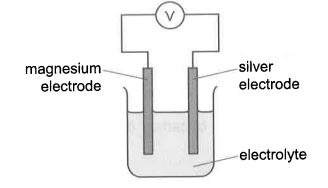
Answer: C (the magnesium electrode loses electrons). Magnesium is much more reactive than silver, so it has the stronger tendency to lose electrons and form ions: \(\text{Mg} \to \text{Mg}^{2+} + 2e^-\). This makes magnesium the negative terminal, where oxidation occurs, so the magnesium electrode loses electrons — statement C is correct.
The electrons released travel from the magnesium electrode to the silver electrode through the external wire, not through the electrolyte; inside the electrolyte it is the ions that carry the charge. So option A is wrong. Option B is wrong because the cell shows magnesium is more reactive than silver, not the reverse. Option D is wrong because silver, as the positive terminal, is reduced (it gains electrons), not oxidised.
The answer is C, which follows directly from magnesium being higher in the reactivity series than silver.
Get the Sec 3 / Sec 4 recording package
Every O Level Pure Chemistry TYS MCQ solution video, plus full Sec 3 / Sec 4 topic recordings.
Find out more