2020 O Level Chem P1 Q12 — Electrolysis / Products of Electrolysis Solution
Question
Video Solution
Explanation
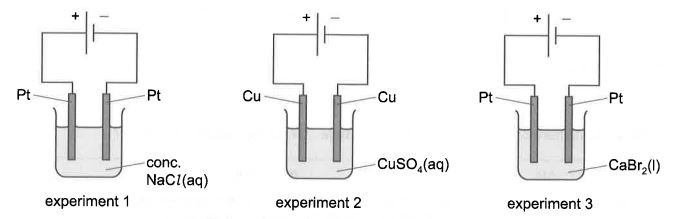
Answer: A (experiment 1 only). A gas at the negative electrode (the cathode) means a cation is discharged to give a gas, and the only common gas formed at a cathode is hydrogen. In experiment 1, concentrated aqueous sodium chloride with inert electrodes contains Na⁺ and H⁺; since sodium is far more reactive than hydrogen, H⁺ is discharged and hydrogen gas, H₂, is released at the cathode. That counts.
In experiment 2, copper(II) sulfate with copper electrodes discharges Cu²⁺ at the cathode, depositing copper metal, not a gas. In experiment 3, molten calcium bromide contains only Ca²⁺ and Br⁻; the cathode discharges Ca²⁺ to give calcium metal, while bromine gas forms at the anode, not the cathode.
So only experiment 1 produces a gas at the negative electrode, giving answer A.
Get the Sec 3 / Sec 4 recording package
Every O Level Pure Chemistry TYS MCQ solution video, plus full Sec 3 / Sec 4 topic recordings.
Find out more