2019 O Level Chem P1 Q40 — Polymers / Addition and Condensation Polymerisation Solution
Question
Video Solution
Explanation
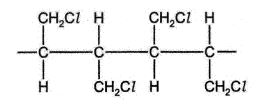
Answer: A (made by addition polymerisation of the monomer with a C=C double bond). The polymer has a repeating unit in which two carbon atoms each carry a hydrogen and a CH₂Cl group, a saturated chain with no double bonds along the backbone.
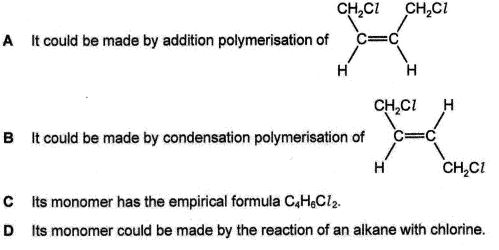
Such a chain is formed by addition polymerisation: the monomer is an alkene, CH(CH₂Cl)=CH(CH₂Cl), whose C=C double bond opens up so that many monomers join head-to-tail into a long saturated chain with no small molecule lost. That makes statement A correct.
Condensation polymerisation (B) is wrong because it needs monomers with two functional groups that eliminate a small molecule such as water; an alkene undergoes addition, not condensation. The claim about the empirical formula (C) is wrong because the simplest ratio of the repeat unit C₄H₆Cl₂ is actually C₂H₃Cl. And making the monomer by reacting an alkane with chlorine (D) is wrong because that gives a chloroalkane by substitution, with no C=C double bond to polymerise. So the answer is A.
Get the Sec 3 / Sec 4 recording package
Every O Level Pure Chemistry TYS MCQ solution video, plus full Sec 3 / Sec 4 topic recordings.
Find out more