2019 O Level Chem P1 Q34 — Organic Chemistry / Cracking Solution
Question
Video Solution
Explanation
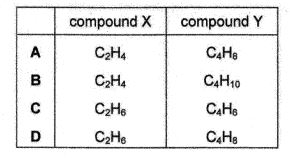
Answer: A (X = C₂H₄, Y = C₄H₈). Cracking breaks the long alkane \(\text{C}_{10}\text{H}_{22}\) into smaller molecules: \(\text{C}_{10}\text{H}_{22} \to \text{C}_4\text{H}_{10} + \text{X} + \text{Y}\).
X has two carbon atoms and decolourises aqueous bromine, so X is an alkene with a C=C double bond — ethene, C₂H₄. The decolourising of bromine water is the standard test for unsaturation.
Now balance the equation. Carbon: \(10 = 4 + 2 + (\text{carbons in Y})\), so Y has 4 carbon atoms. Hydrogen: \(22 = 10 + 4 + (\text{hydrogens in Y})\), so Y has 8 hydrogen atoms. That makes Y = C₄H₈, butene, which is also an alkene formed during cracking.
So X = C₂H₄ and Y = C₄H₈, which is row A. The key checks are that an alkene is needed to decolourise bromine, and that the carbon and hydrogen atoms must balance on both sides.
Get the Sec 3 / Sec 4 recording package
Every O Level Pure Chemistry TYS MCQ solution video, plus full Sec 3 / Sec 4 topic recordings.
Find out more