2019 O Level Chem P1 Q28 — Metals / Reactivity Series Solution
Question
Video Solution
Explanation
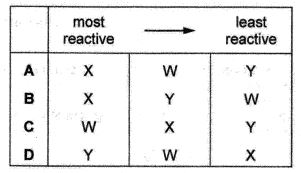
Answer: A (X > W > Y). Use each clue to place the metals against carbon, hydrogen and each other.
X's oxide is not reduced by heating with carbon or with hydrogen. A metal whose oxide resists both reducing agents must be more reactive than both carbon and hydrogen, so X is a very reactive metal, usually extracted by electrolysis.
W's oxide is reduced by both carbon and hydrogen, so W is less reactive than both carbon and hydrogen — a moderately reactive metal. Finally, W displaces Y from aqueous Y sulfate, so W is more reactive than Y.
Putting these together gives the order of reactivity X (most reactive) > W > Y (least reactive), which is row A. The key idea is that the harder it is to reduce a metal's oxide, the more reactive the metal, and displacement from solution confirms the more reactive metal pushes the less reactive one out.
Get the Sec 3 / Sec 4 recording package
Every O Level Pure Chemistry TYS MCQ solution video, plus full Sec 3 / Sec 4 topic recordings.
Find out more