2019 O Level Chem P1 Q25 — Group I / Reactions of Lithium Solution
Question
Video Solution
Explanation
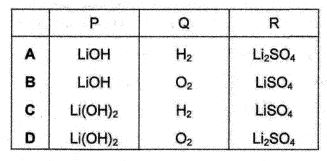
Answer: A (P = LiOH, Q = H₂, R = Li₂SO₄). Lithium is a Group I metal and reacts with water: \(2\text{Li} + 2\text{H}_2\text{O} \to 2\text{LiOH} + \text{H}_2\). So solution P is lithium hydroxide, LiOH, and gas Q is hydrogen, H₂.
Lithium hydroxide is an alkali, so it neutralises dilute sulfuric acid: \(2\text{LiOH} + \text{H}_2\text{SO}_4 \to \text{Li}_2\text{SO}_4 + 2\text{H}_2\text{O}\). The salt R is lithium sulfate, Li₂SO₄.
Because lithium is in Group I, its ion is Li⁺ with a single positive charge, so the hydroxide is LiOH (not Li(OH)₂) and the sulfate is Li₂SO₄ (two Li⁺ balancing one SO₄²⁻). The combination P = LiOH, Q = H₂ and R = Li₂SO₄ is row A. The common error is to give lithium the wrong charge and write formulae such as Li(OH)₂ or LiSO₄.
Get the Sec 3 / Sec 4 recording package
Every O Level Pure Chemistry TYS MCQ solution video, plus full Sec 3 / Sec 4 topic recordings.
Find out more