2019 O Level Chem P1 Q23 — Air and the Atmosphere / Composition of Air Solution
Question
Video Solution
Explanation
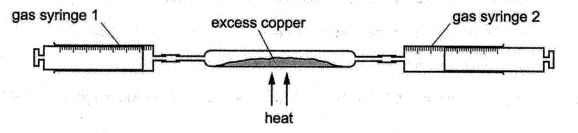
Answer: C (40 cm³). Air is about 20% oxygen and 80% nitrogen, with only small traces of other gases. Passing the air repeatedly over heated copper removes the oxygen: \(2\text{Cu} + \text{O}_2 \to 2\text{CuO}\). The copper turns black as it forms solid copper(II) oxide, while nitrogen does not react.
Of the 50 cm³ of air, the oxygen is \(50 \times 0.20 = 10\,\text{cm}^3\). Once all the oxygen has been removed as solid copper oxide, the gas left is essentially nitrogen, with volume \(50 - 10 = 40\,\text{cm}^3\).
Measured after cooling back to room temperature, 40 cm³ remains, which is option C. This experiment is a classic way of showing that oxygen makes up roughly one fifth of air. The common error is to forget to cool the gas to room temperature or to misread the 20% oxygen figure.
Get the Sec 3 / Sec 4 recording package
Every O Level Pure Chemistry TYS MCQ solution video, plus full Sec 3 / Sec 4 topic recordings.
Find out more