2019 O Level Chem P1 Q22 — Qualitative Analysis / Tests for Gases Solution
Question
Video Solution
Explanation
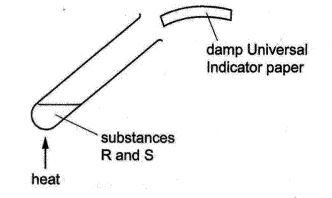
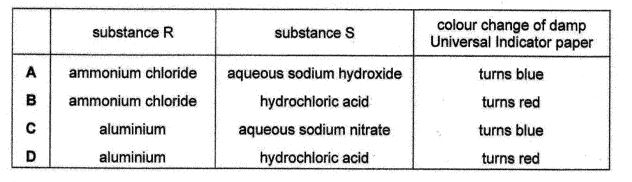
Answer: A (ammonium chloride and aqueous sodium hydroxide, turning the paper blue). When ammonium chloride is heated with aqueous sodium hydroxide, ammonia gas is released: \(\text{NH}_4\text{Cl} + \text{NaOH} \to \text{NaCl} + \text{H}_2\text{O} + \text{NH}_3\). Ammonia is alkaline, so it turns the damp Universal Indicator paper held above blue. This is the standard test for the ammonium ion.
The other rows fail either on chemistry or on observation. Ammonium chloride with hydrochloric acid produces no gas, so the paper would not change. Aluminium with aqueous sodium nitrate does not reduce the nitrate to ammonia without sodium hydroxide present, so no alkaline gas forms. Aluminium with hydrochloric acid gives hydrogen, \(2\text{Al} + 6\text{HCl} \to 2\text{AlCl}_3 + 3\text{H}_2\), which is neutral and leaves the paper unchanged. Only row A matches both the correct chemistry and the colour change, so the answer is A.
Get the Sec 3 / Sec 4 recording package
Every O Level Pure Chemistry TYS MCQ solution video, plus full Sec 3 / Sec 4 topic recordings.
Find out more