2019 O Level Chem P1 Q18 — Rate of Reaction / Catalysts and Temperature Solution
Question
Video Solution
Explanation
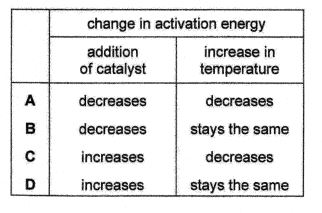
Answer: B (catalyst decreases the activation energy; raising the temperature leaves it unchanged). These two factors speed a reaction up by different means.
A catalyst provides an alternative reaction pathway with a lower activation energy. More of the colliding molecules now have at least the activation energy, so the rate increases. The effect on the activation energy is to decrease it.
Increasing the temperature does not change the activation energy, which is a fixed property of the reaction pathway. Instead, raising the temperature gives the molecules more kinetic energy, so a greater fraction of them have energy at or above the activation energy and collisions are more frequent and energetic. The activation energy itself stays the same.
So a catalyst decreases the activation energy while a temperature rise leaves it unchanged, which is row B. The common error is to think heating lowers the activation energy too.
Get the Sec 3 / Sec 4 recording package
Every O Level Pure Chemistry TYS MCQ solution video, plus full Sec 3 / Sec 4 topic recordings.
Find out more