2019 O Level Chem P1 Q17 — Rate of Reaction / Effect of Concentration Solution
Question
Video Solution
Explanation
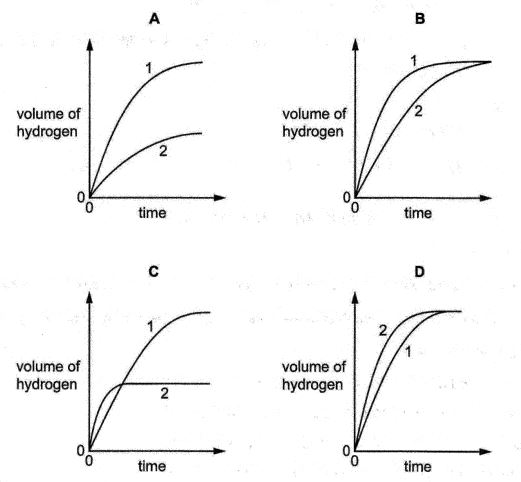
Answer: D (curve 2 steeper, both reaching the same final volume). The reaction is \(\text{Mg} + 2\text{HCl} \to \text{MgCl}_2 + \text{H}_2\). With 1.2 g of magnesium, \(n(\text{Mg}) = 1.2/24 = 0.050\) mol, needing 0.10 mol of HCl to react completely.
Experiment 1: \(0.100 \times 1 = 0.100\) mol HCl. Experiment 2: \(0.050 \times 2 = 0.100\) mol HCl. Both supply exactly 0.10 mol of acid, so both fully react the same 0.050 mol of magnesium and produce the same 0.050 mol of hydrogen. Both curves therefore plateau at the same final volume.
Experiment 2 uses the more concentrated acid (2 mol/dm³), so collisions are more frequent and the reaction is faster: curve 2 rises more steeply at the start before levelling off at the same height. That is graph D. The common error is to expect different final volumes, but the moles of hydrogen are identical.
Get the Sec 3 / Sec 4 recording package
Every O Level Pure Chemistry TYS MCQ solution video, plus full Sec 3 / Sec 4 topic recordings.
Find out more