2019 O Level Chem P1 Q16 — Energetics / Enthalpy of Combustion Solution
Question
Video Solution
Explanation
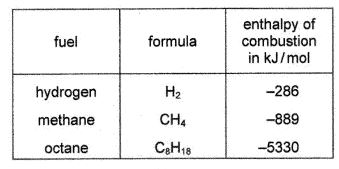
Answer: D (statement 3 only). Compare the fuels using their enthalpy changes of combustion.
Statement 1: wrong. Per gram, divide the energy released by the relative molecular mass. Hydrogen gives \(286/2 = 143\,\text{kJ/g}\), methane \(889/16 \approx 56\,\text{kJ/g}\) and octane \(5330/114 \approx 47\,\text{kJ/g}\). Octane gives the least energy per gram, not the most.
Statement 2: wrong. One mole of hydrogen is 2 g and releases 286 kJ, so 1 g releases \(286/2 = 143\,\text{kJ}\), not 286 kJ.
Statement 3: correct. Combustion of methane is exothermic (\(\Delta H_c\) is negative), which means the energy released in bond forming exceeds the energy absorbed in bond breaking. So the energy required for bond breaking is less than the energy released in bond forming. Only statement 3 is correct, giving D. The common error is to compare fuels per mole rather than per gram, or to forget that one mole of hydrogen has a mass of 2 g, both of which make statements 1 and 2 look correct when they are not.
Get the Sec 3 / Sec 4 recording package
Every O Level Pure Chemistry TYS MCQ solution video, plus full Sec 3 / Sec 4 topic recordings.
Find out more