2019 O Level Chem P1 Q14 — Electrolysis / Electrolysis of Copper(II) Sulfate Solution
Question
Video Solution
Explanation
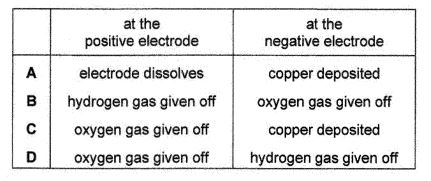
Answer: C (oxygen at the positive electrode, copper at the negative electrode). The cell uses an inert carbon anode and a copper cathode in aqueous copper(II) sulfate.
At the negative electrode (cathode), copper ions from solution gain electrons and are deposited as copper metal: \(\text{Cu}^{2+} + 2\text{e}^- \to \text{Cu}\). Copper is below hydrogen in the reactivity series, so it is discharged in preference to hydrogen.
At the positive electrode (anode), the carbon is inert and does not dissolve. The anions present are hydroxide and sulfate; hydroxide is discharged in preference because the sulfate ion is very stable, giving oxygen gas: \(4\text{OH}^- \to \text{O}_2 + 2\text{H}_2\text{O} + 4\text{e}^-\).
So oxygen is given off at the positive electrode and copper is deposited at the negative electrode, which is row C. The trap is assuming the carbon anode dissolves like a copper anode would; an inert electrode does not.
Get the Sec 3 / Sec 4 recording package
Every O Level Pure Chemistry TYS MCQ solution video, plus full Sec 3 / Sec 4 topic recordings.
Find out more