2019 O Level Chem P1 Q11 — Stoichiometry / Reacting Masses and Limiting Reagent Solution
Question
Video Solution
Explanation
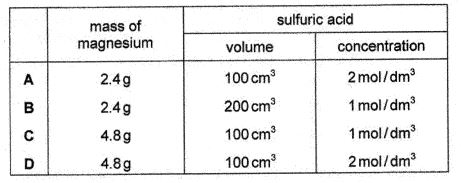
Answer: D (4.8 g Mg with 100 cm³ of 2 mol/dm³ sulfuric acid). The equation \(\text{Mg} + \text{H}_2\text{SO}_4 \to \text{MgSO}_4 + \text{H}_2\) is 1:1:1.
To collect 4.8 dm³ of hydrogen at r.t.p. we need \(4.8/24 = 0.20\) mol of H₂, so 0.20 mol of magnesium and 0.20 mol of sulfuric acid must both react. The mass of magnesium needed is \(0.20 \times 24 = 4.8\,\text{g}\), and 0.20 mol of acid in 100 cm³ means a concentration of \(0.20/0.100 = 2\,\text{mol/dm}^3\).
Row D supplies exactly 4.8 g of magnesium with 100 cm³ of 2 mol/dm³ acid, the matching stoichiometric quantities. The distractors fall short: rows giving only 2.4 g of magnesium (0.10 mol) yield just 2.4 dm³, and a row with 4.8 g of magnesium but only 1 mol/dm³ acid makes the acid limiting, again giving only 2.4 dm³.
Get the Sec 3 / Sec 4 recording package
Every O Level Pure Chemistry TYS MCQ solution video, plus full Sec 3 / Sec 4 topic recordings.
Find out more