2018 O Level Chem P1 Q40 — Organic Chemistry / Isomerism and Polymers Solution
Question
The structures of two compounds, X and Y, are shown. Which statements are correct? 1 Both X and Y contain four carbon atoms per molecule. 2 Both X and Y contain a carbon atom that has four different groups attached to it. 3 X could form a polymer while Y could not.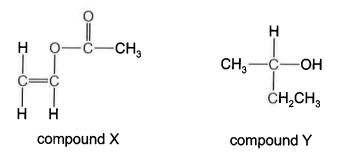
Correct answer: C
Video Solution
Explanation
Answer: C (1 and 3 only). Compound X is \(\text{CH}_2=\text{CH-O-CO-CH}_3\) and compound Y is butan-2-ol, \(\text{CH}_3\text{-CH(OH)-CH}_2\text{CH}_3\).
Statement 1 is true: X has 4 carbons (2 in \(\text{CH}_2=\text{CH}\) and 2 in \(\text{O-CO-CH}_3\)) and Y has 4 carbons. Statement 3 is true: X contains a C=C bond, so it can undergo addition polymerisation, whereas Y has no C=C and cannot.
Statement 2 is false: in Y the second carbon has four different groups, but no carbon in X has four different groups attached. So only statements 1 and 3 are correct. Answer C.
Get the Sec 3 / Sec 4 recording package
Every O Level Pure Chemistry TYS MCQ solution video, plus full Sec 3 / Sec 4 topic recordings.
Find out more