2018 O Level Chem P1 Q37 — Organic Chemistry / Alkenes and Addition Solution
Question
Which displayed formula represents the product of the reaction between propene and bromine?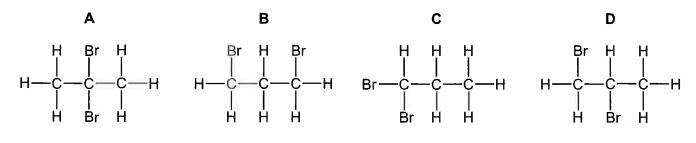
Correct answer: D
Video Solution
Explanation
Answer: D. Bromine adds across the C=C double bond of an alkene by electrophilic addition, with one bromine atom going onto each of the two carbons of the double bond.
Propene, \(\text{CH}_2=\text{CH-CH}_3\), reacts with \(\text{Br}_2\) to give 1,2-dibromopropane, \(\text{CH}_2\text{Br-CHBr-CH}_3\): a bromine on carbon 1 and a bromine on the adjacent carbon 2, with a plain \(\text{CH}_3\) as carbon 3. This is structure D.
A (both bromines on carbon 2) and C (both on carbon 1) are gem-dibromides, not addition products. B (bromines on carbons 1 and 3) cannot form by addition across the C=C bond. Answer D.
Get the Sec 3 / Sec 4 recording package
Every O Level Pure Chemistry TYS MCQ solution video, plus full Sec 3 / Sec 4 topic recordings.
Find out more